
Flying Blind
By Harry James Forkan
The day we brought you into this world was the most emotionally confusing day of our lives. I remember thinking that we were prepared; we had read all the books and bought all the colourful safety installations to baby-proof a house that was barely big enough for two, and that was confusing. It was confusing to live in a house surrounded by things that you had bought but that weren’t yours, for a person that wasn’t even there yet. It was confusing to try to remember all the different, sometimes contradictory advice about feeding and sleeping and everything in-between. Just the act of trying to keep up-to-date with what was considered out-of-date was Sisyphean. We were flying in the dark, checking and rechecking all the lights and dials, unable to see where we were actually going. Those final weeks were so confusing, and they were scary too.
It was scary thinking about the possibilities that we never talked about. We knew the statistics, at least, we knew the bad ones. It was scary to consider the deepest, darkest ‘What if?’s. It was scary to think about what might happen to you. There are so many things that can go wrong and only one thing that can go right, which is for nothing to go wrong. I was also scared of what might happen to me, and to your mother. I had read, in my own time, about postpartum depression—a sickness that can fall on anyone—and it scared me to think of your mother falling ill like that. How could I take care of you by myself? I thought about it non-hypothetically, just in case. I felt ashamed, in a way. Ashamed of trying to be prepared for the worst.
I was scared of what would happen to me through the stress and the lack of sleep, not to mention the financial burden of everything we didn’t know we needed yet. They say a baby’s screaming is psychologically triggering for men, something buried deep in our consciousness from the savannah that puts us into fight or flight, and that’s why those first few months are so difficult on the psyche. ‘Don’t shake the baby’ I kept reading, thinking it was just a joke. ‘Don’t shake the baby, even if you think you could never’ again and again—could I really find myself doing that one day? I knew the statistics; I was ashamed that I had to take it seriously.
The days before were scary, but when your mother called me on the day, it was downright terrifying. The scramble to her office; the speeding down the motorway like a madman. Half carrying her through the hospital doors while she was huffing and puffing; I tried to stay calm for her, and between you and me, I think I did a pretty good job fronting it. I kept telling her that everything was going to be totally fine, but I was getting notifications from my watch telling me that I was experiencing a ‘cardiac abnormality’. I remember feeling glad I was in a hospital, just in case.
There was an excitement in the terror, or rather there were excitements. There was the excitement of an ending, that finally this ordeal was about to be over, but there was also the distinctly different excitement of something new beginning—I suppose there always is, but in this case, the new beginning was you.
When they brought your mother and me into the room, it was different. I had read about this moment, how ‘For the father, it all becomes real in the room,’ and ‘Men become fathers when they see the baby,’ and well, they were half true. I can’t say that that’s when it all became real, because I had known exactly how real everything was before, but in there, it’s like there was nothing else besides the real, if that makes sense. Everything else dissolved away into a dream land that I couldn’t care less about. All the money in my wallet meant nothing to me in there, it was just colourful paper. All the pointlessly flagged emails on my phone were just pixels on a screen. Some people say it’s like an out-of-body experience, but I had never felt more present in my entire life.
The labour was hard for your mother. I know she’ll tell you one day that it was nothing but that’s because she’s the strongest person you’ll ever meet. I know it was hard for her, not just because I received a hair-line fracture in my hand from her squeezing it, but because I saw the look in her eyes that told me she knew something wasn’t right. I told her it was okay. I don’t think she heard me, but I couldn’t say it again because I just didn’t know. I just had to be there, and be comforting, but I was as confused and scared as she was. There was more pushing, more breathing, more squeezing. The nurses and midwives were like robots, in the best way. They were like the Terminator; they were iron. No emotion, just doing exactly what needed to be done, and it was incredible. It was reassuring. It made me think that things were going to be normal. I had read enough to know that what happened next was not normally meant to happen.
When they brought you out, there was no cry. There was only the echo of your mother’s last scream, seeping into the walls. There was the beeping of machines, and the short, shallow breaths from the bed. Her grip on my hand loosened, but I still held it tight. One of the midwives peeled off and saw to her. She started acting reassuring, and that’s when I knew something was wrong. The doctor called for something that I didn’t understand and bodies moved around the room so flawlessly; it was like watching ballet. I think about that moment often. I see it in slow motion in my head. I remember moving towards the doctor, and one of the nurses putting her hand on my arm. I know that I said, out loud, ‘Something’s wrong,’ and I know it wasn’t a question.
A midwife approached you with a small metal canister connected to an even smaller mask: your first ever toy. In that moment all the confusion, all the fear, all the terror; it felt like deep down I had always known this was going to happen. It felt like, in the blackest pit of my stomach, I knew it was all too good to be true. I felt frozen, ashamed that I even let myself get carried away thinking that things could just be normal. I couldn’t see you yet, you were still being held low, behind the hem of your mother’s gown as it was suspended between her knees. I just wanted to see you, to know, to confirm to myself that I was right only in knowing nothing could ever go right. I just wanted to see our girl, to know that it actually happened.
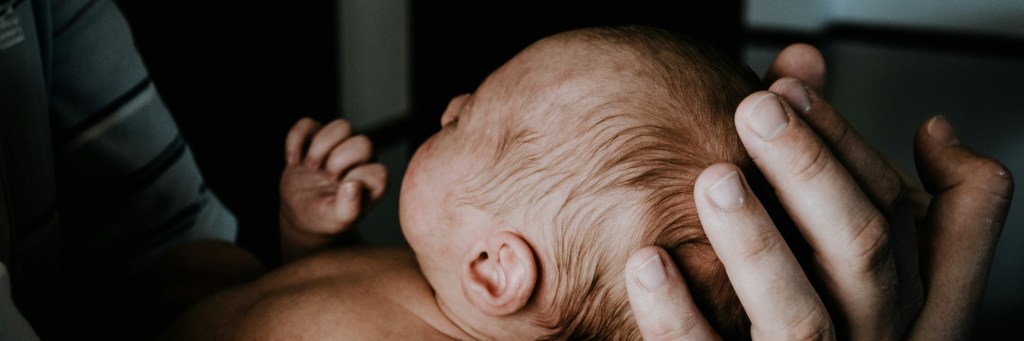
The midwife who had the mask in her hand stopped. I saw her frozen too, with tears welling in her eyes. The robot, this iron woman showing the first sliver of emotion. It was enough to split me in two. Your mother was sat up now, speechless. I looked at her and saw her covering her mouth, shaking, realising. When I looked back to the nurse she met my eyes, and her cheeks pulled back into a strange, strained smile. I was so confused. I was scared. I was present and I wanted to wake up from this nightmare. That’s when I heard it. A scream, a cry; it was you. Our little fighter, stronger than the whole world. Our Hope.
They say a baby’s scream is psychologically triggering for fathers. Maybe, under normal circumstances, that is true—I don’t know for sure. All I do know is that sometimes I have nightmares of silence, of that room and that moment, and to be woken by your cry is the best feeling in the whole world.
Harry James Forkan
Harry James Forkan is a Writer and Photographer from Dublin,
Ireland. He is currently working on a collection of short stories to self
publish, alongside various photographic projects. You can find him on
Instagram @h_forkan_